




How Physical Therapy Tackles Hip Pain
You want to take care of some chores or go for a walk — but hip pain is keeping you on the couch. If this sounds familiar, know that you don’t have to suffer! At McCabe and Brady Physical Therapy, our McKenzie-trained physical therapists will guide you through a simple process to address your hip pain by identifying the source of your symptoms and treating that source directly so you can get active again.
This newsletter will take you through that process, from understanding your symptoms to the outcomes you can expect from physical therapy. Still have questions? Call us to schedule an appointment!
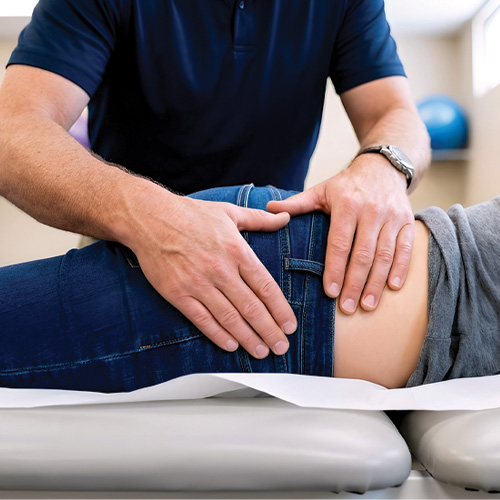
Pinpoint Your Symptoms
There are several potential reasons why someone might develop hip pain. To treat your pain effectively, we need to pinpoint what that cause could be.
When you visit us for your initial appointment, one of the first things we’ll do is ask you to share your symptoms. “Hip pain” often causes a lot more than just pain, and being able to describe your pain, mobility limitations, and other concerns helps us get a clearer picture of your condition.
For example, you know that your hip hurts. But when do you experience pain (i.e., during activity)? Does your pain come and go? Where do you experience pain? Is it just in your hip, or do you feel it elsewhere? Is the pain a dull ache? Sharp and shooting?
Make sure to share additional symptoms you might be experiencing, too. Here are some common ones:
- Stiffness/limited range of motion in your hip
- Weakness throughout the lower extremities
- Mobility issues, including walking, going up or down stairs, or struggling to stand up
- Difficulty performing everyday tasks, such as putting on your shoes — and let us know which ones
Identify a Cause and Develop a Treatment Plan
Thanks to your detailed symptom description — as well as a health history and comprehensive physical exam — your therapist should be able to determine the underlying cause of your hip pain. At McCabe and Brady Physical Therapy, our therapists use Cyriax and McKenzie principles, to evaluate and monitor your responses to treatment and make sure it is producing the desired result.
If you’re 55 or older, there’s a good chance your hip pain stems from osteoarthritis. This degenerative condition causes cartilage and bone tissue to break down, leading to pain and restricted mobility.
However, hip pain can also stem from an injury. If you’re an athlete or particularly active person, you may have suffered an acute injury, such as a labral tear, in which a ring of cartilage in the hip socket becomes damaged. You may have also sprained your hip — that is, damaged the ligaments that hold the joint together.
However, even if you haven’t had an obvious injury, an injury could still be to blame. Overuse injuries are injuries that develop gradually and, in the hip, generally affect the soft tissue — your muscles, tendons, and ligaments. They usually occur due to repetitive movements or improper biomechanics.
Your treatment plan will vary based on the underlying cause of your pain, but in most cases, we aim to…
- Help manage acute pain with manual therapy, modalities, or gentle stretches.
- Improve mobility and range of motion through targeted stretches and exercises.
- Build strength in the muscles surrounding the hip to support the joint.
- Restore your ability to perform everyday movements, such as going upstairs — and for the athletes, we’ll help restore your ability to perform sport-specific movements.
- Teach you how to manage symptoms between visits with a home exercise program designed around your evaluation findings.
Understand Your Outcomes
As with treatments, your exact outcomes will vary based on the underlying cause. However, other factors can come into play, too, such as age, health status, and the amount of time you can spend with physical therapy (whether in the clinic or performing home exercise programs).
For example, osteoarthritis has no cure, but you can manage your symptoms with regular physical activity. If you stick with your prescribed exercise program, you can minimize pain, slow the progression of your condition, and potentially delay or even avoid surgery.
If you suffered an injury, you likely will be able to improve your hip pain, usually within 1-3 months. However, if your injury was severe, full rehabilitation — the point at which you’ve fully restored strength and function — may take longer. Continuing any prescribed exercises is important even if you no longer feel pain.
Start Your Own Journey to Hip Pain Relief Today
No matter the reason for your hip pain, the McKenzie-trained physical therapists at McCabe and Brady Physical Therapy will guide you toward lasting relief. Our goal is to identify the source of your symptoms, treat that source directly, and help you return to the activities that matter most.
Call us today to schedule an appointment to get started!
Get Started with PT Now!
Return to McCabe and Brady Physical Therapy and Let’s Continue Your Journey to Wellness Together. Schedule Your Appointment Now!

These Caesar-Marinated Chicken Kabobs with Zucchini and Grilled Romaine bring bold summer flavor to the table with juicy grilled chicken and fresh seasonal vegetables. It’s a satisfying, protein-packed meal that’s perfect for cookouts, weeknight dinners, or healthy outdoor dining.
Enjoy This Seasonal Healthy Recipe!
Caesar-Marinated Chicken Kabobs with Zucchini and Grilled Romaine
- 2 anchovy fillets, finely chopped
- 1 small garlic clove, minced or grated
- ⅓ cup grated Parmigiano Reggiano
- ¼ cup fresh lemon juice
- 5 Tbsp Greek Yogurt
- 1 Tbsp extra-virgin olive oil, plus more if needed for the romaine
- 1 ½ tsp Dijon mustard
- ½ tsp freshly ground black pepper
- 1 ¼ pounds skinless boneless chicken breast or thighs, cut into 1-inch cubes
- 8 long wooden or metal skewers
- 1 zucchini
- 1 large or 2 small heads romaine
- ½ tsp kosher salt
- Cooking spray
To make the Caesar marinade
- Add the anchovies, garlic and pepper to a large bowl and use your fork to mash into a paste.
- Add the cheese, lemon juice, yogurt, 1 Tbsp olive oil, mustard, and pepper and stir to combine.
- Reserve half for serving.
- Add the diced chicken to the bowl with the remaining dressing and stir to coat.
- Set aside to marinate at room temperature for 30 minutes or refrigerate overnight.
For the kabobs
- If using wooden skewers on an outdoor grill, soak them in water for at least 30 minutes.
- Trim the ends from the zucchini, halve it lengthwise, and cut it into semicircles between ½- and 1-inch thick.
- Separately, cut the romaine in half (if using small heads) or quarters (if using a large head), leaving the root ends intact.
- Lightly spray or coat the cut sides with oil.
- Thread the chicken onto doubled skewers, alternating every few pieces with a slice of zucchini, for a total of 4 kabobs. Place the kabobs on a large plate or baking sheet and, when they’re assembled, season lightly with salt.
- Preheat the grill with medium-high heat and oil the grates. Grill the kabobs for 6 to 8 minutes total, turning every 2 to 3 minutes, until the chicken is cooked through and well browned.
- When the chicken is done, grill the romaine flat side down until it’s lightly charred in places but still bright green and crisp, about 30 seconds per side.
- Serve the romaine alongside the kabobs and drizzle the remaining marinade over both.
June Word Scramble
brerireastws
aaointcv
unesecnsr
emrmus
dnelomea
iaordungta
Answer Key
strawberries
vacation
sunscreen
summer
lemonade
graduation
What’s A HEP — And Why Is It So Important to Your Success?
HEP stands for “home exercise program.” If you’re undergoing physical therapy with McCabe and Brady Physical Therapy, there’s a good chance your therapist will prescribe one to you.
It’s important to note that a HEP isn’t the same as an at-home workout program. With an at-home workout, your goal is general fitness. A HEP consists of curated exercises to help you achieve your rehabilitation goals.
We understand that an exercise routine can sometimes be difficult to work into a busy lifestyle. Therefore, we design our HEPs to be as straightforward as possible, with…
- Exercises you’ve done before
- A small time commitment
- Strategies for managing pain, if needed
- Clear instructions on when and how to complete each exercise
However, we also want to make sure you understand why we prescribe a HEP at all! In fact, a HEP has multiple benefits:

1. It reinforces your treatment plan:
Your home exercises support the work you do in the clinic and help your body respond between visits.
2. It improves outcomes:
Patients who complete their prescribed HEP experience faster and more effective rehabilitation.
3. It helps develop a good habit:
Even after you recover, regular physical activity is essential for good health. By completing your HEP, you get into the habit of moving daily.
In short, a HEP is a small way to make big changes! At McCabe and Brady Physical Therapy, your home exercise program is designed around your specific condition, symptoms, and goals so you can take an active role in your recovery. And if you think you might benefit from a personalized HEP, call us to schedule a consultation.
Exercise of the Month
FIGURE 4 BRIDGE
Begin on your back. Bend your knees and keep your back flat on the ground. Cross one leg over the other so that your legs make a “4”. Gently, contract your abdominals and hold to keep your back flat as you move up into the bridge position. Remember to breathe. Gently, squeeze your butt muscles and lift your hips off the ground. The goal is to have your hips aligned with your knees and shoulders.
3 Sets, 10 Reps.
Follow Us on Social Media!

Follow the buttons below to find McCabe and Brady on your favorite social media sites and stay up to date with what happens around our clinic!
Thank you for subscribing
to McCabe and Brady Physical Therapy

6 Tips for a Healthy Summer
Your diet affects many aspects of your well-being including your immune system, bone health, muscle function, inflammation and pain. In summer, it can be difficult to keep good nutrition at the forefront especially with barbeques and cookouts popping up everywhere you look — so here are six simple ways to help you stay healthy this season.
1
Swap Snacks for Fruits & Vegetables
2
Replace Steak with Fish
3
Reduce Saturated Fat Intake
4
Cut Down on Sugary Drinks
5
Drink Enough Water
6
Don’t Skip Breakfast
Personalized Care.
Powerful Results.
Refer a Friend

If you’ve experienced the outstanding care at McCabe and Brady Physical Therapy, why not share it with your friends? Referring them means giving them access to personalized treatment that can make a real difference in their health and well-being. Help them find a trusted healthcare partner—refer a friend to McCabe and Brady Physical Therapy today!
Meet Our Team

Alexandra Prophet
DPT, Cert. MDT

Douglas Brady
DPT, JD, Cert. MDT, AIB-VRC

Frank McCabe
MPT, B.S. Ex. Phys., Cert. MDT

Lauren Suchanick
DPT, Cert. MDT, AIB-VRC

Richard Winters
PT, DPT, OCS, Dip. MDT

Steve Smeck
BS. Ex. Phys, DPT