
Need help managing a gait disorder?
What exactly is a gait disorder?
Gait is defined as a person’s walking pattern. Walking requires precise timing and coordination of muscles, joints, and nerves in order for the body to propel forward rhythmically. Our stride differs from person to person based on height, weight, health status, and even culture.
Gait disorders are extremely common in the adult population, with studies revealing that more than 60% of people over the age of 80 have a gait disorder. Balance, shuffling, frequent falls, staggering, and freezing in place are all symptoms of gait disorders.
Our gait can be affected by neurological or non-neurological causes.
The following are the most common causes:
- Neurological conditions (i.e., sensory or motor impairments)
- Orthopedic problems (i.e., osteoarthritis, sciatica, plantar fasciitis, and other skeletal deformities)
- Medical conditions (i.e., heart failure, respiratory insufficiency, peripheral arterial occlusive disease, and obesity)
- Joint degeneration/arthritis
- Vestibular disorders/vertigo
- Injuries to the spine and/or lower extremity
- Muscle disorders (i.e., weakness, muscle wasting associated with age)
Neurological issues
A variety of neurological conditions can cause gait problems. Possible causes include a brain injury, Parkinson’s disease, muscular dystrophy, cerebral palsy, or a stroke. Some neurological disorders begin in childhood, while others develop with age.
The following are the most common conditions affecting children:
• Cerebral palsy
• Muscular dystrophy
• Charcot Marie Tooth disease
• Brain tumors
The most common affecting adults include:
• Multiple sclerosis (MS)
• Stroke
• Brain tumor
• Parkinson’s disease
• Spinal cord compression
Orthopedic Disorders and Injuries
The most common causes of non-neurological gait disorders in adults are osteoarthritis and skeletal deformities/injuries of the lower extremities. A sudden injury, disease, accident, or condition that causes changes in joint range of motion, muscle weakness, or avoidance of weight-bearing (aka limping) can disrupt your normal gait and negatively impact your normal functioning.
A limited range of motion, weakness, changes in stride length, cadence, asymmetrical stepping, or limping are all symptoms of orthopedic gait disorders.
Physical therapy can help you recover from gait disorders!
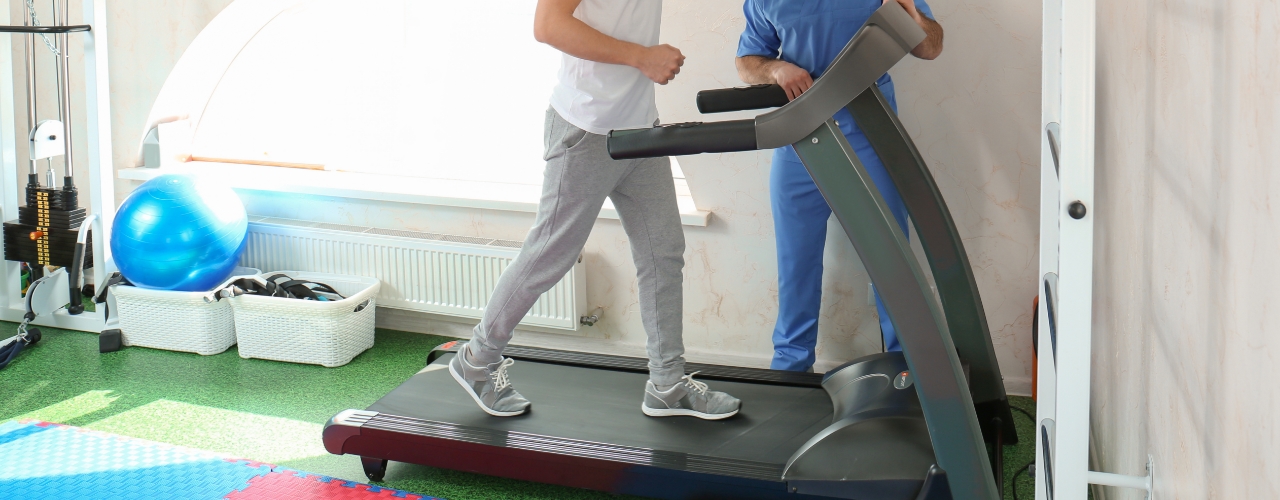
One of the most effective treatments in Warminster, New Britain and Elkins Park, PA for all gait disorders is physical therapy. Our physical therapist will examine your entire body to determine the factors that are contributing to your condition. We will include a range of motion and strength tests for your joints. We will also perform movement screenings to determine how your body moves in specific patterns.
Our physical therapists commonly use the following techniques and exercises:
Mobility work
Stretching in the clinic and at home will help you increase your range of motion in all of the joints that may be limiting your natural gait.
Strengthening Exercises
Strength in the core and lower extremities is essential for normal gait. Weakness in the hips and pelvis can have a significant impact on your normal gait pattern.
Other muscle weaknesses can affect your stride length and cadence, making you more prone to falls and injuries. Our team will identify any areas of weakness and provide you with targeted exercises to address them and restore your functional gait.
Gait Retraining Exercises
Learning proper movement techniques, also known as retraining, can sometimes correct gait abnormalities. Based on your gait, your therapists will give you specific cues and instructions.
Drills can range from simple weight shifts for people who struggle to bear all of their weight on one leg to advanced cues about foot placement with eyes forward.
In some cases, your therapist may use exaggerated movements of the head, arms, trunk, and lower extremities to stimulate the nervous system and re-calibrate the systems’ interactions. This type of therapy can also improve the gait patterns of runners.
Balance and Coordination Drills
Our musculoskeletal system’s intricate timing necessitates balance and coordination, working in tandem to achieve the rhythmic stride we use when walking.
Drills can range from simple single-leg balancing to complex ladder drills requiring high levels of coordination across the entire body and its systems.
Use of Assistive Devices
Using an assistive device to achieve the safest, most effective gait is sometimes necessary. A physical therapist typically selects an assistive device based on its level of stability.
From most stable to least stable, the following are typical devices:
• Walker
• Rolling walker
• Quad cane (i.e., cane with four prongs on the bottom)
• Crutches (i.e., axillary or lofstrand)
• Standard cane
• Hiking Sticks
In the clinic, your therapist will assess you to determine which device will benefit you and fit you appropriately to ensure your safety. Your therapist will then practice using the device with you until you are comfortable using it on your own.
Your Next Steps…
Request An Appointment
Receive A Custom Treatment Plan
Work Hard and Progress In Your Recovery
Enjoy Life Pain-Free!